
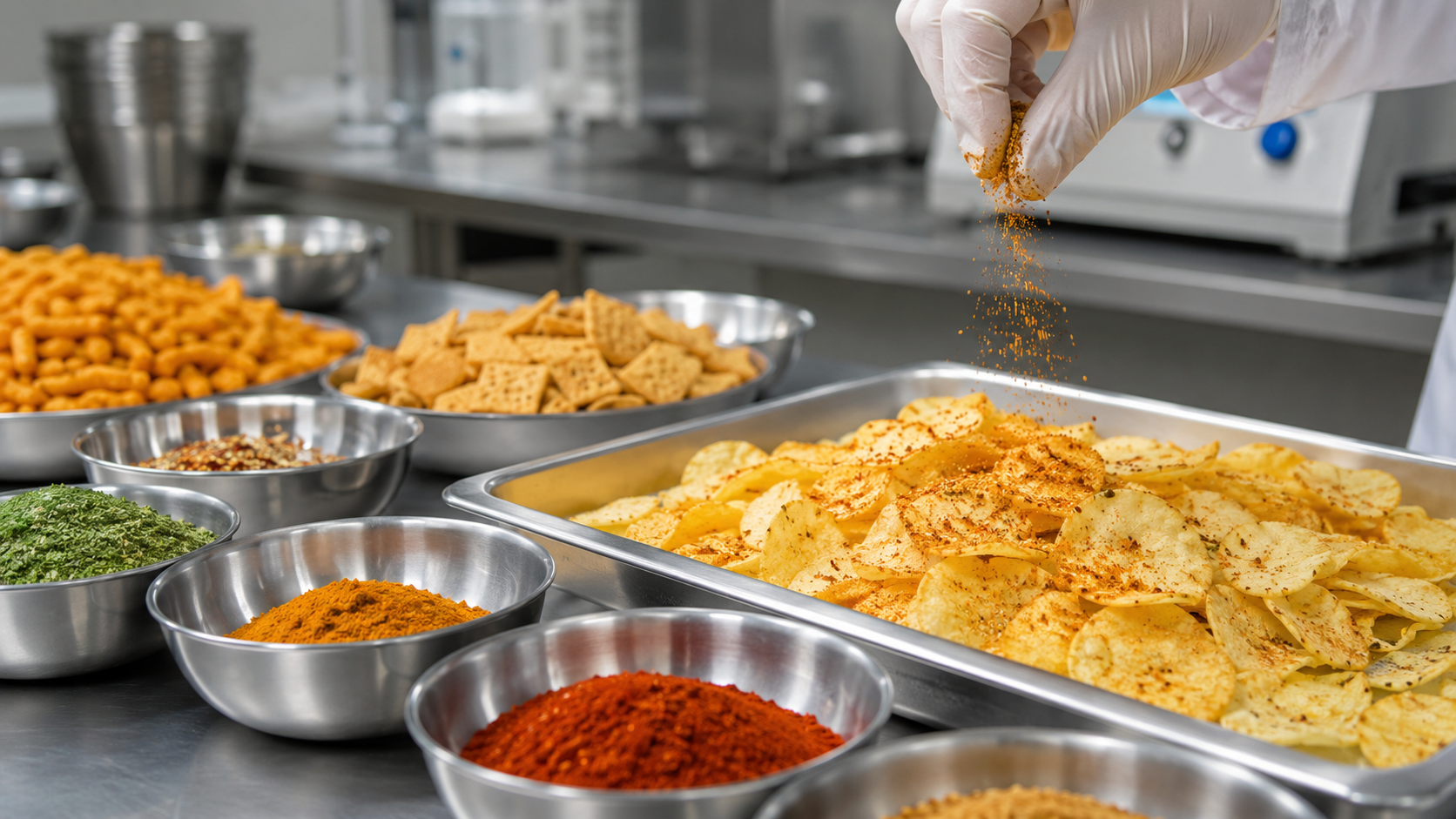
For years, the snack industry ran on a fairly predictable set of flavor standards: barbecue, cheddar, sour cream & onion, ranch. These profiles sold well, and for good reason. They were familiar, easy to execute, and broadly appealing. But the market has shifted.
Consumer expectations in 2026 have moved toward more precise regional flavor cues, with broad "international" descriptors giving way to profiles inspired by specific cuisines, ingredients, and seasoning traditions. That shift is landing directly on the production side, where food manufacturers are now being asked to deliver layered, complex seasoning systems at scale, reliably, and often faster than before.
For product developers and procurement teams, this creates a real operational question: is your seasoning supplier built for what the snack category is becoming?
The Flavor Bar Has Moved
The "swicy" (sweet and spicy) wave that dominated recent years is already evolving. Sweet and spicy combinations are now giving way to more layered profiles like "swangy" (spicy, sweet, and tangy) and "swavory" (spicy, sweet, and savory), with consumers seeking dynamic sensory experiences rather than single-note flavor hits.
MENA spice blends like berbere, za'atar, harissa, and sumac are finding their way into protein rubs, flavored oils, and functional snacks, while Latin American ingredients like tamarind, tropical fruits, and chili peppers are moving beyond ethnic category positioning into mainstream snack applications.
This is showing up in RFQs, innovation briefs, and product development timelines. The question is not whether these flavor directions are relevant. It is whether your current supplier can actually formulate them.
What This Means for Seasoning Blends Specifically
Complex flavor profiles do not just require more ingredients. They require precision.
There is increasing demand for two-step seasoning systems that combine a liquid base with dry ingredient layering, allowing manufacturers to create more complex sensory profiles and visual differentiation. At the same time, ingredient systems are becoming more technically demanding, with natural flavors, alternative sweeteners, and plant-based components often presenting properties that are heat-sensitive or prone to separation.
For seasoning suppliers, this raises the bar significantly. Building a blend that performs correctly as a dry topical coating on a chip or cracker, one that sticks evenly, does not clump in humid conditions, and delivers a consistent flavor experience across thousands of pounds of production, is not the same as developing a table seasoning. The formulation has to be designed for the application, not just the flavor profile.
Particle size, moisture content, flow behavior, and ingredient interactions all matter. A blend developed for a retail jar behaves differently than one designed for a drum tumbler or a continuous coating line.
The Private Label Angle
Economic pressure and private label growth continue to influence snack purchasing decisions in 2026, with value increasingly defined by quality ingredients and satisfying sensory experiences rather than low price alone.
For private label brands and co-manufacturers, this creates a real opportunity. Retailers are asking for more sophisticated flavor options under their own labels, profiles that used to belong exclusively to national brands. Delivering on that requires access to custom formulation support, not just a commodity spice supplier who can fill a drum.
The difference is having a partner who can develop a proprietary blend, lock in the formula, and reproduce it consistently across every run, without requiring the brand to manage the raw ingredient complexity themselves.
Scalability Is Still the Real Test
Trend-driven formulation is straightforward in a lab. The challenge is scaling it.
A harissa-inspired seasoning blend might work beautifully at 50 pounds. At 5,000 pounds, the variables multiply. Blending time, ingredient ratios, particle distribution, and batch uniformity all need to be controlled. If any one ingredient in the blend varies in moisture or grind size between shipments, the finished product feels different to the end consumer, even if the formula has not changed.
This is where sourcing infrastructure matters. Manufacturers building bold flavor pipelines need seasoning partners with the equipment and raw material relationships to deliver at scale, not just at bench.
Conclusion
The snack category is demanding more from its flavor systems, and that demand is moving upstream. For procurement teams and product developers, the sourcing conversation is no longer just about price per pound. It is about whether your seasoning partner can help you get a complex, market-ready profile from brief to production and keep it stable from the first batch to the thousandth.
Working with a supplier who understands both the formulation side and the production side makes that process significantly more manageable. The right partner brings raw material relationships, blending infrastructure, and technical support to the table so your team can focus on the product, not the supply chain behind it.
Sources
Symrise In-Sight. "The World Is on the Menu: How Global Flavor Trends Are Reshaping F&B Manufacturing in 2026."
Food Dive. "From 'Newstalgia' to 'Swangy': The Flavor Trends Taking Over 2026."
Symrise In-Sight. "Snack Trends for 2026: What B2B Food & Beverage Teams Should Build Next."
Snack Food & Wholesale Bakery. "Efficiency and Easy Changeover Top the List of Seasoning and Coating Must-Haves."