
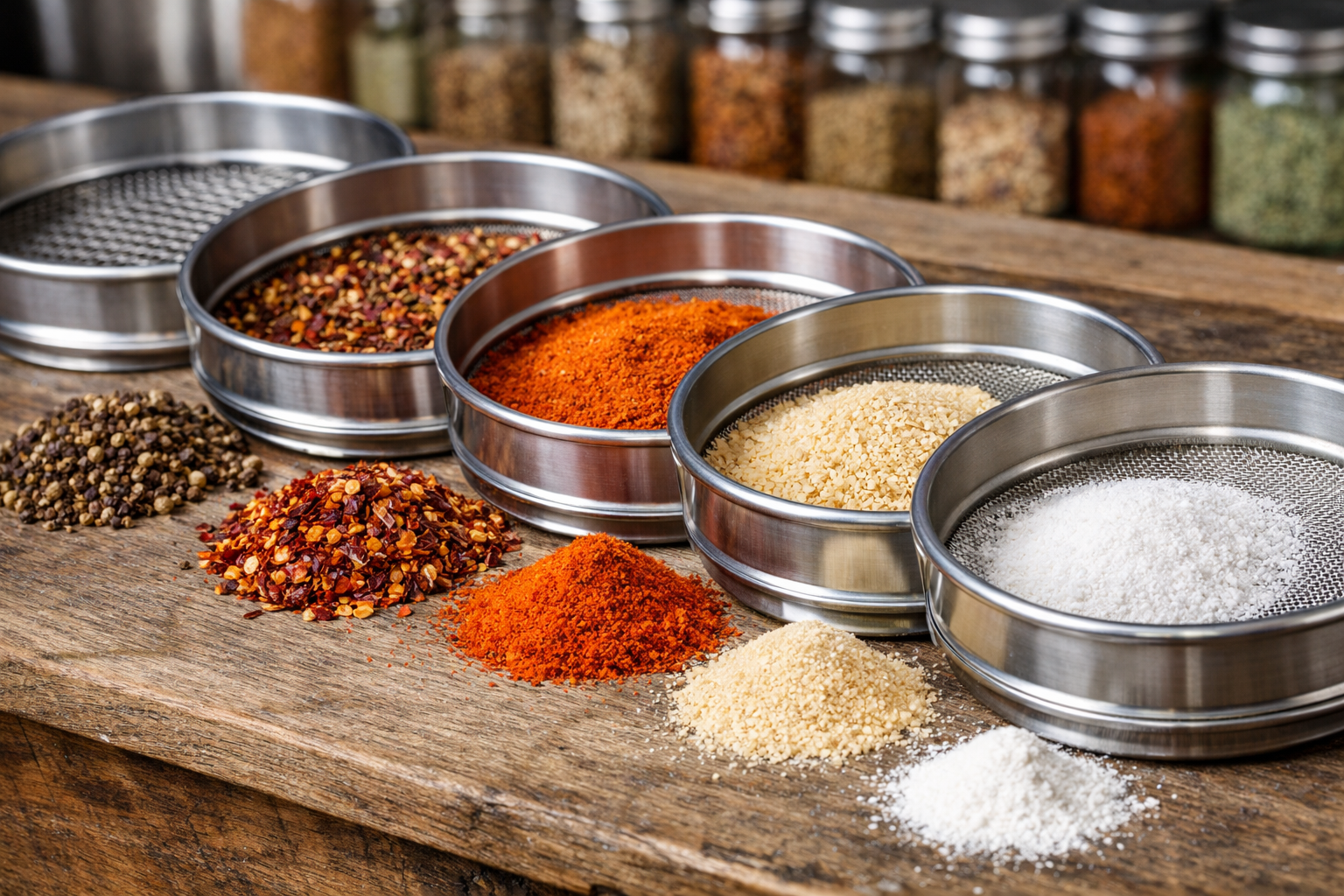
Spice mesh size directly affects flavor release, extraction yield, blend consistency, and processing efficiency. Learn how mesh size works and how to choose the right grind.
When buyers specify 8 mesh black pepper or 40 mesh paprika, they’re not just talking about appearance. Mesh size — also called particle size — influences how a spice behaves in real applications: how fast flavor is released, how evenly it blends, how it flows through equipment, and even how much product is lost during processing.
For food manufacturers, blenders, and bulk buyers, mesh size is not a technical detail — it’s a performance variable.
What does mesh size mean in spices?
Mesh size comes from the U.S. standard sieve system. Each mesh number refers to a screen with a specific number of openings per linear inch.
In simple terms:
-
Lower mesh number = larger particles (coarser grind)
-
Higher mesh number = smaller particles (finer grind)
So:
-
8–14 mesh = visibly coarse
-
16–28 mesh = medium to medium-fine
-
30–40 mesh = fine powder
It’s also important to know that most spice specs are ranges, not single particle sizes. A product labeled “16/20 mesh” usually means it passes through a 16-mesh sieve but is retained on a 20-mesh sieve.
Common spice mesh sizes (practical reference)
| Mesh size | Approx. opening | Typical use |
|---|---|---|
| 8 | ~2.36 mm | cracked spices, rubs |
| 10 | ~2.00 mm | coarse blends |
| 12 | ~1.70 mm | grinder blends |
| 14 | ~1.40 mm | coarse-medium |
| 16 | ~1.18 mm | foodservice blends |
| 18 | ~1.00 mm | medium-fine |
| 20 | ~850 µm | uniform dispersion |
| 30 | ~600 µm | fine powders |
| 40 | ~425 µm | sauces, batters |
This table is widely used as a procurement and QC reference, but performance always depends on more than just the number.
How mesh size affects flavor
1. Flavor release speed
Finer particles have more exposed surface area. That means:
-
faster hydration
-
quicker aroma release
-
stronger immediate flavor impact
This is why fine chili powders or garlic powder hit quickly in sauces and soups.
2. Texture and perception
Coarser particles behave differently:
-
slower flavor release
-
visible spice pieces
-
more texture and bite
Cracked pepper on steak is a good example — the flavor unfolds gradually during cooking instead of hitting all at once.
3. Aroma stability
Finer grinds tend to lose volatile compounds faster after grinding because more surface area is exposed to air. Coarser grinds often retain aroma longer during storage, depending on packaging and moisture.
How mesh size affects yield (extraction & infusion)
For customers working with:
-
oil infusions
-
marinades
-
spice extracts
-
industrial flavor processing
particle size directly influences extraction efficiency.
Smaller particles allow solvents or oils to contact more of the spice material, often improving yield. However, extremely fine powders can:
-
compact too tightly
-
slow filtration
-
create diminishing returns
In practice, many processors balance fineness vs. flowability rather than chasing the smallest possible grind.
How mesh size impacts processing and manufacturing
1. Blend consistency
When ingredients with very different particle sizes are mixed, segregation can occur during:
-
conveying
-
vibration
-
packaging
-
transport
This leads to inconsistent flavor from batch to batch. That’s why many manufacturers specify not just mesh size, but particle size distribution or percentage passing.
2. Flow and line performance
Mesh size influences:
-
hopper flow
-
auger fill accuracy
-
dust generation
-
packaging losses
Very fine powders are more likely to bridge, dust, or stick, while coarse materials usually flow better but may reduce blend uniformity.
3. Grinding method matters
The way a spice is ground also affects performance. Heat generated during grinding can reduce volatile oils and aroma. For certain spices, low-temperature or cryogenic grinding helps preserve flavor and improve oil retention.
Choosing the right mesh size (real-world examples)
Black pepper
-
8–14 mesh: rubs, steak applications, grinder blends
-
16–28 mesh: standard foodservice blends
-
30–40 mesh: sauces, soups, coatings
Paprika and chili powders
-
Fine meshes: uniform color and flavor distribution
-
Coarser meshes: visible speckle, reduced dusting, different mouthfeel
Garlic and onion
-
Granulated: better flow, less dust, texture in blends
-
Powder: fast hydration, strong immediate impact, higher caking risk
Mesh size alone is not enough (important QC specs)
To avoid performance issues, mesh size should be paired with:
-
sieve range definition (e.g. 20/40)
-
percentage passing
-
moisture or water activity
-
bulk density
-
grinding method specification
This is where many supply issues start — the mesh number matches, but the behavior does not.
What to Keep in Mind
Mesh size affects far more than appearance. It influences:
-
how fast flavor is released
-
how evenly spices blend
-
how efficiently they extract
-
how smoothly your line runs
Treat mesh size as a functional specification, not a label. When defined properly, it reduces waste, improves consistency, and delivers predictable results across applications.
Sources
-
ASTM E11 – Standard Specification for Woven Wire Test Sieve Cloth and Test Sieves
-
Gilson Company – Sieve Size & Mesh Conversion Tables
-
Endecotts – Particle Size Analysis and Sieve Designation Guides
-
MDPI (Applied Sciences) – Studies on particle size reduction and extraction efficiency
-
MDPI (Processes) – Powder flow behavior and particle properties
-
ScienceDirect – Grinding methods and volatile oil retention in spices