
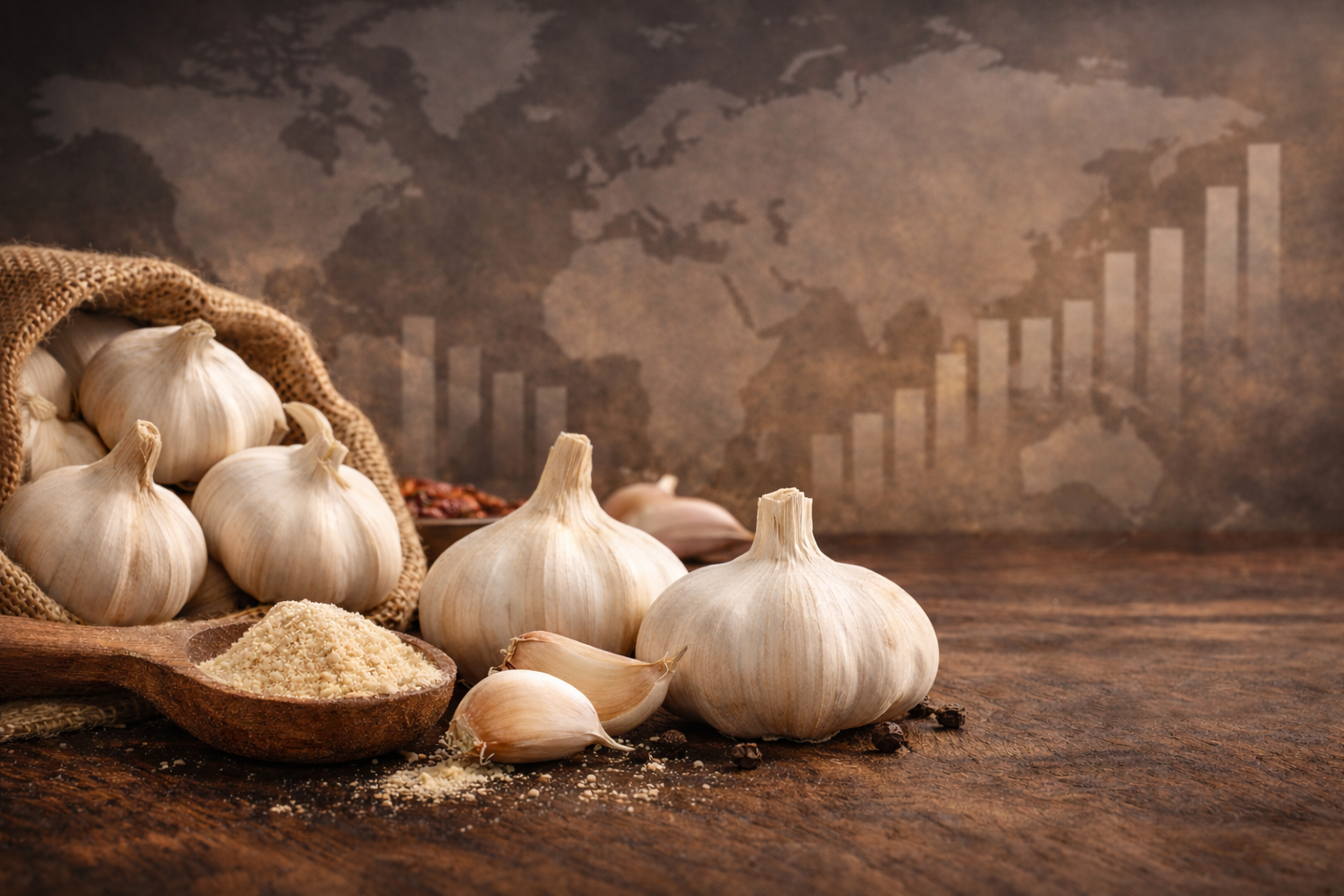
Garlic is one of the most widely used ingredients across food manufacturing, foodservice, and retail. While it is often viewed as a “stable” commodity, the 2026 season is shaping up with tighter supply conditions than usual due to weather-related disruptions in key producing regions.
For B2B buyers, this matters early. Garlic pricing, availability, and lead times tend to react quickly when production uncertainty appears, especially given how concentrated global supply is.
Global garlic supply: where the market stands
Global garlic production is highly concentrated. China accounts for roughly 70–75% of global garlic output, making it the dominant exporter to most international markets. Other relevant producers include:
- India – primarily for domestic use, with limited export volumes
- Spain – a key supplier for the EU market
- Egypt – an important exporter, especially to Europe and the Middle East
- Argentina – seasonal supplier to North America and Latin America
Because of this concentration, any disruption in major producing regions tends to ripple quickly through global supply chains.
Weather disruptions and their impact on the 2026 crop
Reports from late 2025 and early 2026 indicate that unfavorable weather conditions affected garlic-growing regions in parts of China and Southern Europe. These included:
- Excess rainfall during planting and early growth stages
- Localized flooding in some producing areas
- Irregular temperature patterns impacting bulb development
While final harvest volumes are still being assessed, early indicators suggest:
- Yield variability rather than total crop failure
- Quality inconsistencies, particularly in bulb size and storage performance
For buyers, this combination often leads to tighter grading availability and more selective export volumes.
Pricing pressure and market sensitivity
Garlic markets tend to be price-sensitive when inventories tighten. Unlike grains, garlic has:
- limited long-term storage flexibility
- quality degradation risks over time
When supply tightens, the market typically sees:
- faster price movements
- stronger competition for export-grade product
- reduced flexibility for spot buyers later in the season
Even moderate production shortfalls can result in disproportionate pricing pressure, especially for dehydrated garlic, granules, and powder used in industrial applications.
Can alternative origins offset supply risk?
While buyers often look to diversify away from China during tight markets, alternative origins have limitations:
- Spain and Egypt: reliable quality, but limited capacity compared to global demand
- Argentina: seasonal availability and longer transit times
- India: strong domestic consumption limits export volumes
In practice, these origins can help supplement supply, but they are unlikely to fully replace Chinese volumes if global demand remains steady.
What this means for B2B buyers
For sourcing and procurement teams, the 2026 garlic market highlights the importance of early planning.
Key considerations include:
- Lead times: Export availability may tighten earlier than usual
- Specification flexibility: Being open to size or format adjustments can help secure supply
- Contract vs. spot strategy: Contract coverage may reduce exposure to short-term volatility
- Inventory planning: Holding slightly higher safety stock may be justified in tight markets
Garlic buyers should also monitor differences between fresh, dehydrated, and processed formats, as each responds differently to supply pressure.
Summary: Garlic Market Implications
- China remains the key driver of global garlic supply and pricing
- Weather-related yield variability is increasing market sensitivity
- Alternative origins can support supply but not fully replace volume
- Early purchasing reduces exposure to spot-market volatility
- Quality and grading consistency may matter as much as price this season
Conclusion
The 2026 garlic season is not defined by a single dramatic supply shock, but by structural tightness and heightened sensitivity following weather disruptions in key producing regions. With inventories more exposed and fewer buffers available, the market is likely to react faster to any additional risk.
For B2B buyers, proactive sourcing strategies, flexible specifications, and early engagement with suppliers will be essential to managing both cost and continuity of supply throughout the year.
Sources
Food and Agriculture Organization of the United Nations. (2024). FAOSTAT: Crops and livestock products.
Mundus Agri. (2025–2026). Global garlic production and market updates.
USDA Foreign Agricultural Service. (2025). Horticultural products: World markets and trade.