
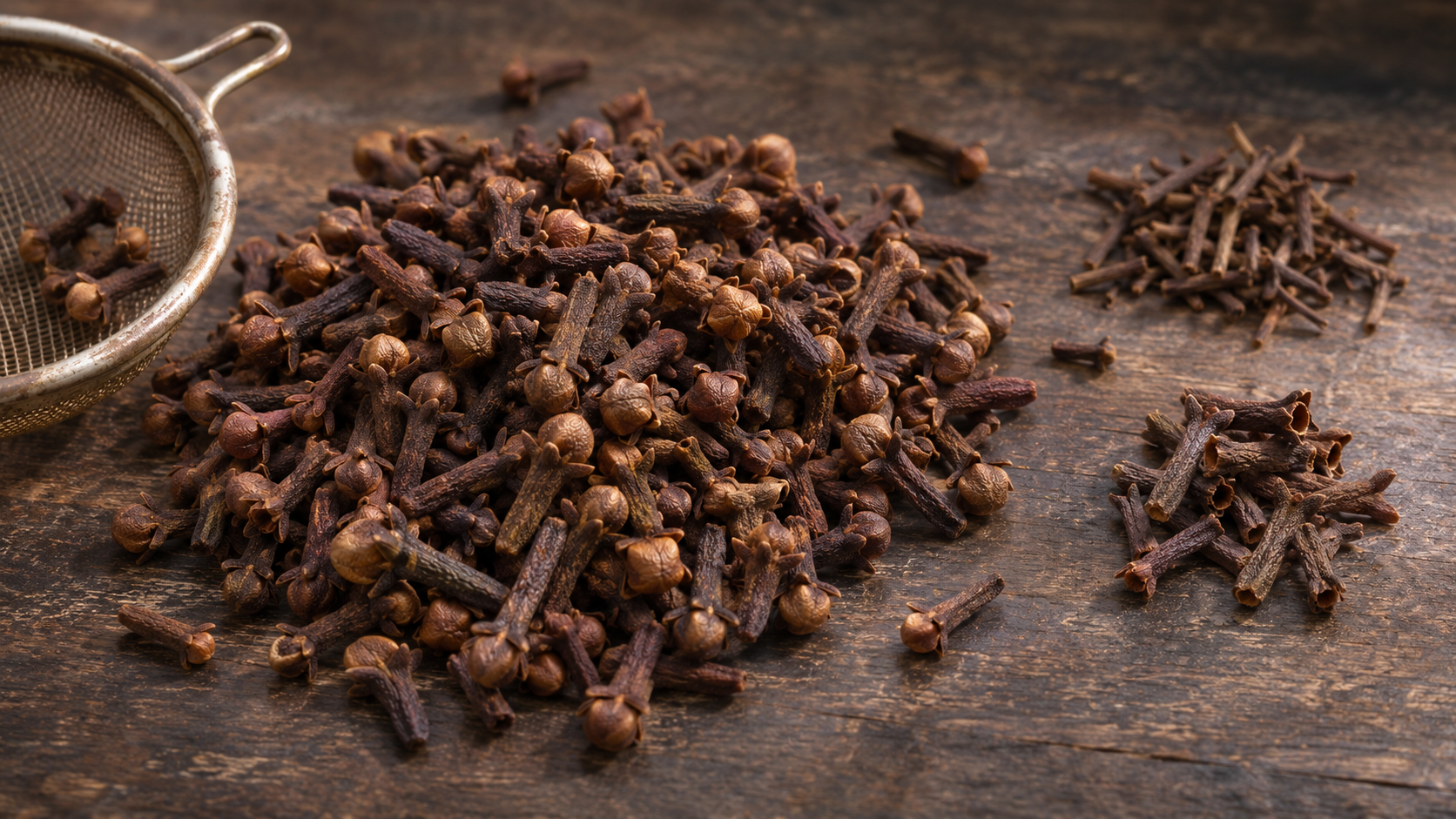
Clove is one of the few spices where a small change in quality shows up immediately in the finished product. Its aroma comes mainly from eugenol, a compound concentrated in the volatile oil of the dried flower bud. When that oil content drops because of age, poor grinding, defects in the lot or buds that were already distilled, the clove note weakens and formulas need more of it to reach the same intensity. For buyers, that makes volatile oil the most useful number on a clove specification.
Where clove’s strength comes from
Cloves are the dried, unopened flower buds of Syzygium aromaticum. Good-quality whole cloves contain roughly 15 to 20 percent volatile oil, one of the highest levels of any culinary spice. Eugenol makes up most of that oil, with eugenyl acetate and β-caryophyllene adding secondary notes.
That composition explains how clove behaves in food. Eugenol is potent at low concentrations, so clove can dominate a blend quickly, and at higher levels its profile shifts from warm and sweet toward medicinal and numbing. The difference between a clove note that supports a product and one that overwhelms it is often a small change in dosage, or in the oil content of the lot.
Volatile oil: the number to put in your spec
ISO 2254 sets minimum volatile oil levels on a dry basis: 17 mL per 100 g for the top two grades of whole cloves and 15 for the third grade, and 16 and 14 respectively for ground cloves. Requiring volatile oil on the COA, tested with a recognized method such as the ASTA method, lets buyers compare lots and suppliers on actual flavor strength instead of appearance.
Volatile oil also explains why price per pound can mislead. A cheaper lot with less oil may need a higher usage rate to deliver the same intensity, which can cancel the savings. When comparing quotes, compare cost per unit of flavor, not only cost per pound.
Defects that reduce flavor strength
| Issue | What it is | ISO 2254 limit, whole cloves (Grade 1 / Grade 2) |
|---|---|---|
| Headless cloves | Buds that lost their round head | 2% / 5% max |
| Khoker cloves | Buds that fermented because they were not fully dried; pale, mealy and wrinkled | 0.5% / 3% max |
| Mother cloves | The oval fruit of the clove tree rather than the flower bud | 0.5% / 4% max |
| Exhausted cloves | Buds whose oil was already distilled | Counted as extraneous matter: 0.5% / 1% max |
| Stems | Pieces of the flower stalk | No separate limit; define one in your own spec |
ISO 2254 also caps moisture at 12% for whole cloves and 10% for ground. In ground cloves, none of these defects can be seen, which is why volatile oil testing matters even more for ground product than for whole. Because the standard sets no separate limit for stems, buyers who want one should add it to their own specification.
Whole or ground
Whole cloves hold their volatile oil much better than ground cloves, because the oil stays protected inside the bud until it is broken. Grinding generates heat and exposes the oil to air, and losses continue during storage. For buyers who grind in-house or need a long shelf life, whole cloves give more control.
For manufacturers who need even dispersion in a dry blend, ground cloves are more practical. In that case, the spec should define volatile oil, particle size and shelf life, and the product should be stored sealed, cool and away from light.
Origin and supply
Indonesia is the largest clove producer, but most of its crop is used domestically, largely by its kretek cigarette industry. Madagascar, Tanzania (Zanzibar), Sri Lanka and the Comoros are major sources for the export market. Because supply depends on a small number of origins, weather or a short crop in one country can move prices quickly, so ask suppliers to state origin on quotes and COAs, especially when switching lots.
What changes in formulation
Eugenol is fat-soluble and partly volatile, so clove tends to read stronger in high-fat systems and can lose top notes during long, open cooking or baking. A dosage that works in a dry rub may taste very different in a sauce or a baked good.
When a formula switches between lots, origins or forms, adjust the usage rate based on volatile oil content and confirm the result in the finished product, not just in the dry blend. The same applies when replacing ground clove with clove oil or oleoresin, which are far more concentrated and need to be standardized before substitution.
A spec that protects the flavor
A clove specification that includes volatile oil, defect limits, moisture, origin and form gives purchasing and R&D the same reference for flavor strength, and makes supplier quotes comparable. To source whole or ground cloves to a defined specification, contact Majestic Spice or explore our Products page.
References
International Organization for Standardization. (2004). ISO 2254:2004 Cloves, whole and ground (powdered). Specification.
Cortés-Rojas, D. F., Fernandes de Souza, C. R., & Oliveira, W. P. (2014). Clove (Syzygium aromaticum): a precious spice. Asian Pacific Journal of Tropical Biomedicine, 4(2), 90–96.
Haro-González, J. N., Castillo-Herrera, G. A., Martínez-Velázquez, M., & Espinosa-Andrews, H. (2021). Clove essential oil (Syzygium aromaticum L. Myrtaceae): Extraction, chemical composition, food applications, and essential bioactivity for human health. Molecules, 26(21), 6387.
American Spice Trade Association. Official Analytical Methods.
U.S. Food and Drug Administration. 21 CFR 184.1257, Clove and its derivatives.